How to Install (macOS)
Preparation
Installation of this software requires three disk image files. Please download each file from the links below.
Main Program
Open Source Calculation Engines, etc.
Additional GNN force field model files (Required only if using FAIR-Chem or SevenNet)
Additionally, Sentinel-LDK-RTE is used as the license manager. Please download the installer from the link below.
Note
Ensure that you install NanoLabo Tool on the same machine where NanoLabo is installed, even if you intend to run calculations on a remote machine.
Installation
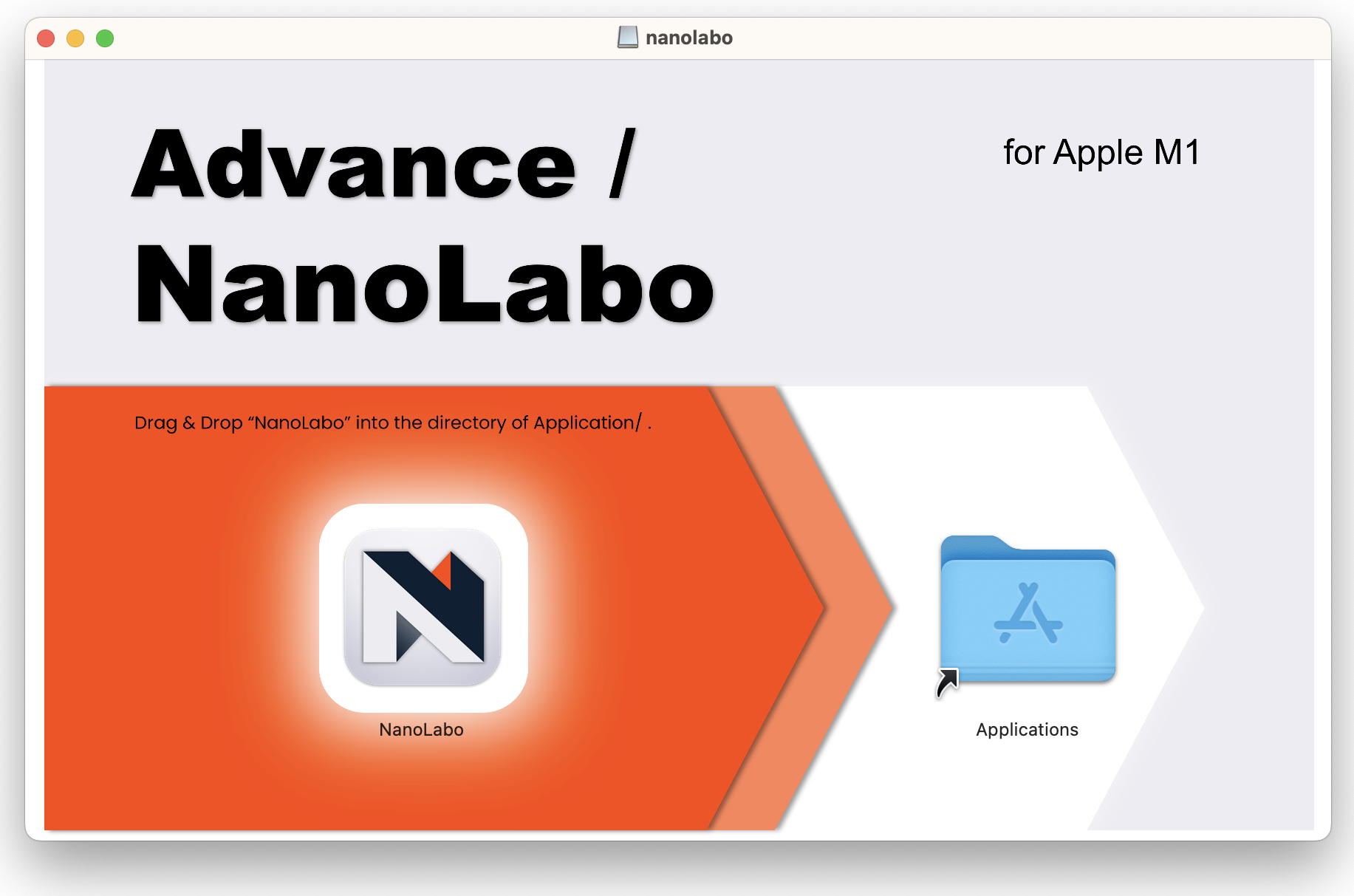
First, open the Advance/NanoLabo dmg file. Once mounted, you’ll see the content of the disk image. Drag & drop the NanoLabo icon to the Applications directory.
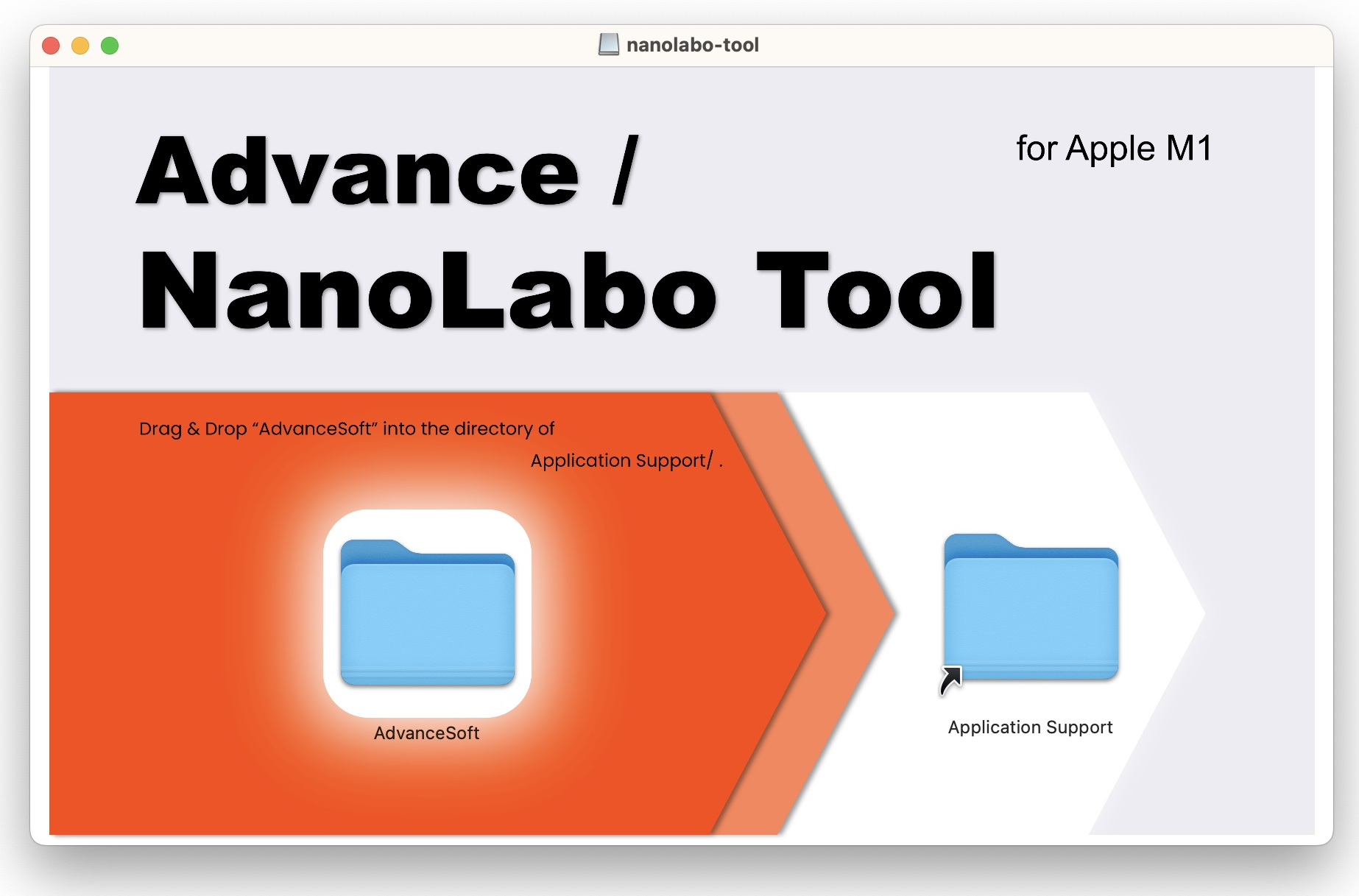
Next, open the Advance/NanoLabo Tool dmg file and drag & drop the AdvanceSoft directory into the Application Support directory.
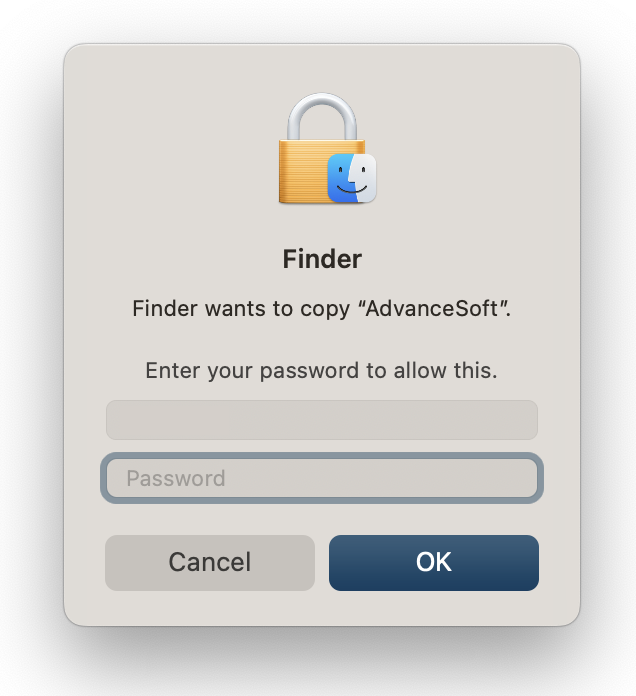
A dialog box asking for authentication will appear. Click Authenticate and enter the your username and password.
If using FAIR-Chem or SevenNet, also install Advance/NanoLabo GNNP. When a confirmation dialog is displayed, select “Merge”.
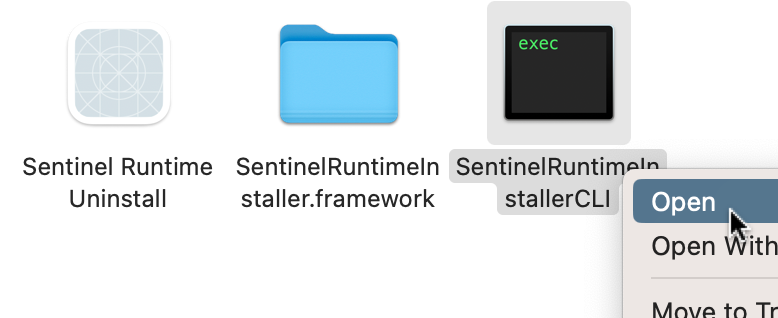
Next, install Sentinel-LDK-RTE. Double-click the downloaded file to extract it, and then run SentinelRuntimeInstallerCLI. If the message “cannot be opened because the developer cannot be verified.” appears, hold down the control key and click the file to open it.
Follow the on-screen instructions to install.
Launching
Launch the software using the NanoLabo icon in the Applications directory.
The first time you open it, you’ll need to grant permission. Please follow this procedure.
Hold down control key, then click to open NanoLabo (do not release control key until you click Open ).
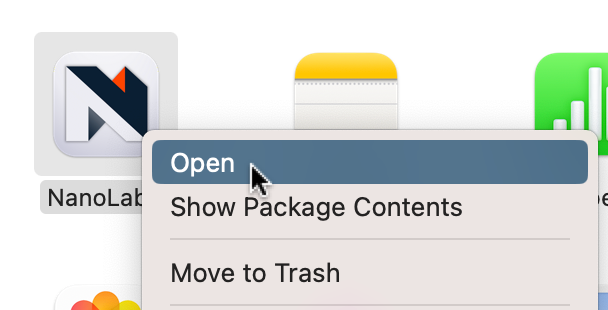
“Verifying” progress bar will appear. This process might take some time, so please be patient.

A dialog will appear asking for confirmation to open the application. Click Open.

When Activate Advance/NanoLabo dialog appears, (if you have logged in as administrator) enter the user account password in the Password of Root box and click OK. This password is used only for executing the commands in place and is never saved.
Alternatively, you can manually open the terminal and execute the commands displayed in Command box as an administrator. For the user other than root user, please prepend
sudoto the command. If you choose this method, an error will appear when you click OK , but the dialog will not show up during subsequent startups if the process is successful.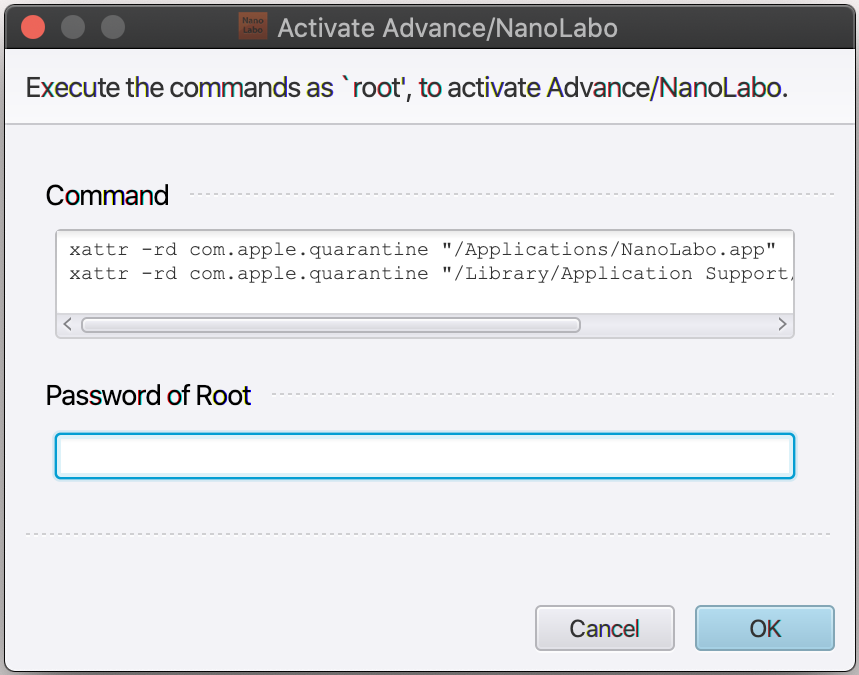
On initial launch, a license dialog will appear. Please follow the procedure here to set up the license.
Additional Settings
Materials Finder API Settings
Configuration of an API key is required to obtain crystal structures from the Materials Project. For the configuration method, please see here.
Configuration for graph neural network universal force field
To use graph neural network universal force fields in LAMMPS calculations, additional setup in a Python environment is required. For the configuration method, please see here.
Configuration for versatile tight-binding method (ThreeBodyTB)
To utilize the versatile tight-binding method (ThreeBodyTB) calculations, additional settings in the Julia environment are necessary. Please refer here for the detailed setup instructions.
Setting up for remote calculation
To submit calculation jobs from NanoLabo to a remote machine, you’ll need to establish an SSH connection. Please refer here for the detailed setup instructions.
Update/Upgrade
When upgrading from the trial version to the full version, a new installation is not required. Please update only the license, referring to License Update.
When updating to a new version, perform the same operations as during the initial installation. When the confirmation prompt appears, select “Replace”.
When updating to a new major version of NanoLabo, a license update is required. Please update the license, referring to License Update.
If a newer version of NanoLabo Tool is available along with NanoLabo, it is recommended to update both. NanoLabo is designed to be used in conjunction with the calculation engines provided in the latest version of NanoLabo Tool.
Your software configurations and any projects you have created are stored separately from the installation directory. This ensures that you can continue using the software seamlessly, even after the update.
Uninstallation
To uninstall NanoLabo, locate and delete it from the Applications directory.
Note
Executable files of calculation engines etc. are stored in /Library/Application Support/AdvanceSoft . You can remove them if desired.
Note
Configuration setting and projects created by this software are stored in home directory/.nanolabo . You can remove them if you want.
Note
To uninstall Sentinel-LDK-RTE, open Sentinel Runtime Uninstall, which is located in the same directory as the Sentinel-LDK-RTE installer. Follow the instructions in the dialog to perform the uninstallation.